HAZOP Scribing of Sulphur Block Process Unit (SBPU) at KGOC
Client Overview: HSE Risk Management Services (HSE-RMS) was engaged to provide scribing support for the Hazard and Operability (HAZOP) Study of the Sulfur Recovery Unit (SRU) at Kuwait Gulf Oil Company (KGOC). The primary objective was to systematically document the HAZOP proceedings in line with applicable standards, ensuring accurate capture of discussions, identified hazards, and recommendations to support safe and efficient plant operations.
Process Technology Overview: The Sulphur Block Process Unit (SBPU) at KGOC is based on Shell licensed technology. The unit comprises three major sections:
- Acid Gas Enrichment Unit (AGEU) – Enhances H₂S concentration in acid gas streams for efficient downstream processing
- Sulphur Recovery Unit (SRU) – Converts hydrogen sulfide (H₂S) into elemental sulfur using the Claus process
- Tail Gas Treating Unit (TGTU) – Treats residual gases to minimize sulfur emissions and meet environmental standards
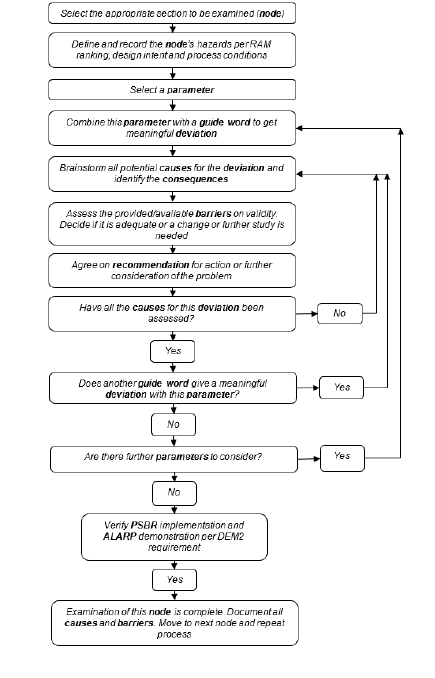
HAZOP Concept: The HAZOP study is a structured and systematic technique used to identify potential hazards and operability issues in process systems. It involves a multidisciplinary team analyzing deviations from design intent using guidewords applied to process parameters.
In this assignment, HSE-RMS was responsible for real-time scribing, ensuring all discussions, deviations, causes, consequences, safeguards, and recommendations were accurately recorded.
HAZOP Methodology: The HAZOP study was conducted in accordance with:
- Shell DEP 80.00.00.15 – Gen (Hazard and Operability Study guideline)
- KOC Recommended Practice KOC-L-017 for HAZOP Studies
The methodology followed a systematic, team-based approach involving detailed examination of process deviations using guidewords applied to key parameters such as flow, pressure, temperature, and composition.