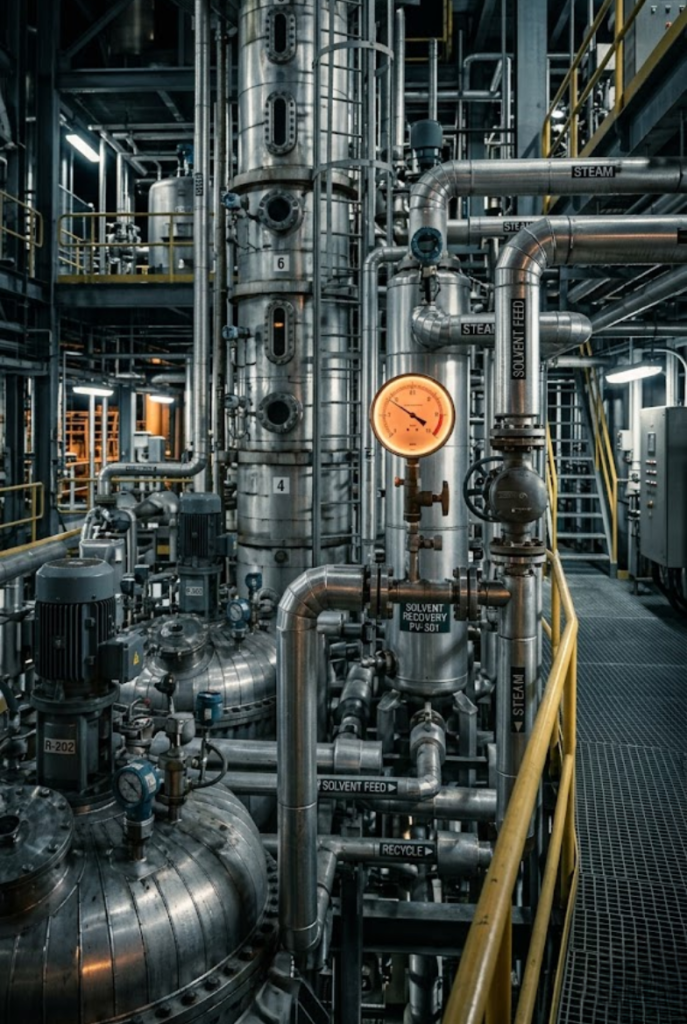
In a recent HAZOP study for an agrochemical plant, our team at HSE Risk Management Services Pvt. Ltd. identified a critical hidden risk in the distillation & solvent recovery system.
At first glance, the process appeared routine.However, during detailed HAZOP discussions with the plant team, key concerns emerged:<br>
⚠️ Increasing concentration of residue during solvent recovery<br>⚠️ Elevated temperature and pressure conditions<br>⚠️ Potential thermal instability under abnormal scenarios
🔍 What changed the game?
We went beyond conventional HAZOP by integrating ARC & DSC thermal study data.
The findings were significant:
- Exothermic decomposition starts at ~140 °C
- Severe secondary decomposition near ~240 °C
- Potential for runaway reaction and high pressure rise (~140 bar)
💡 Critical Insight
A proposed shift to a higher temperature utility (180–190 °C) could push the system dangerously close to decomposition conditions.
👉 This would have reduced the safety margin to near zero.
✅ Final Outcome
Based on our integrated analysis, we recommended:
✔ Use of Low Pressure Steam (LPS) only<br>✔ Limiting reactor temperature to ≤ 130 °C<br>✔ Avoiding high-temperature utilities for this system
🎯 Why this matters
This study reinforced a key process safety lesson:
Distillation is not always just separation—residue behavior can introduce serious thermal risks.
And more importantly:
Heating medium selection is a safety decision, not just an operational choice.
🔗 If you're working with distillation, solvent recovery, or reactive systems, this is a reminder to always combine:<br>✔ Process understanding<br>✔ HAZOP analysis<br>✔ Thermal stability data