HAZID Case Study – Adani Total Gas Limited, Porbandar
Project Number: 24-718.50.02-tuvrh-bct-hse
- Project Overview
A Hazard Identification (HAZID) Study was conducted for the project facilities at Adani Total Gas Limited, LCNG Station at Porbandar, Gujarat to systematically identify potential hazards associated with process operations, materials handled, equipment, and site activities during normal and abnormal operating conditions. The objective of the study was to identify credible hazard scenarios at an early stage of the project and to evaluate their potential impacts on personnel, plant, environment, and surrounding areas, thereby enabling timely risk reduction.
The study involved a structured review of key project information including process descriptions, layout drawings, Piping and Instrumentation Diagrams (P&IDs), Material Safety Data Sheets (MSDS), Standard Operating Procedures (SOPs), and hazardous area classification information. A multidisciplinary team carried out a qualitative assessment of hazards, potential causes, consequences, and existing safeguards, and identified recommendations to eliminate or mitigate risks. The HAZID provides a high-level, systematic basis for early hazard management, supporting safer design decisions, regulatory compliance, and reliable operation of the facility.
- Objective
To identify potential hazards associated with processes, equipment, materials, and site activities at an early stage and assess their possible impacts on personnel, plant, and environment.
To identify existing safeguards and recommend risk reduction measures to support safer design, regulatory compliance, and reliable operation of the facility.
- Methodology
HAZID is used as an early means of hazard identification during the design and development of a project. The method is often used to follow-up on the hazards that have been identified during concept hazard analysis. Hazard Identification was conducted through brainstorming sessions chaired by independent chairman. Project documents including PIDs, Site Layout, Emergency Response Strategy etc., were reviewed and various hazards associated during the project execution and operation were identified and recommendations were suggested.
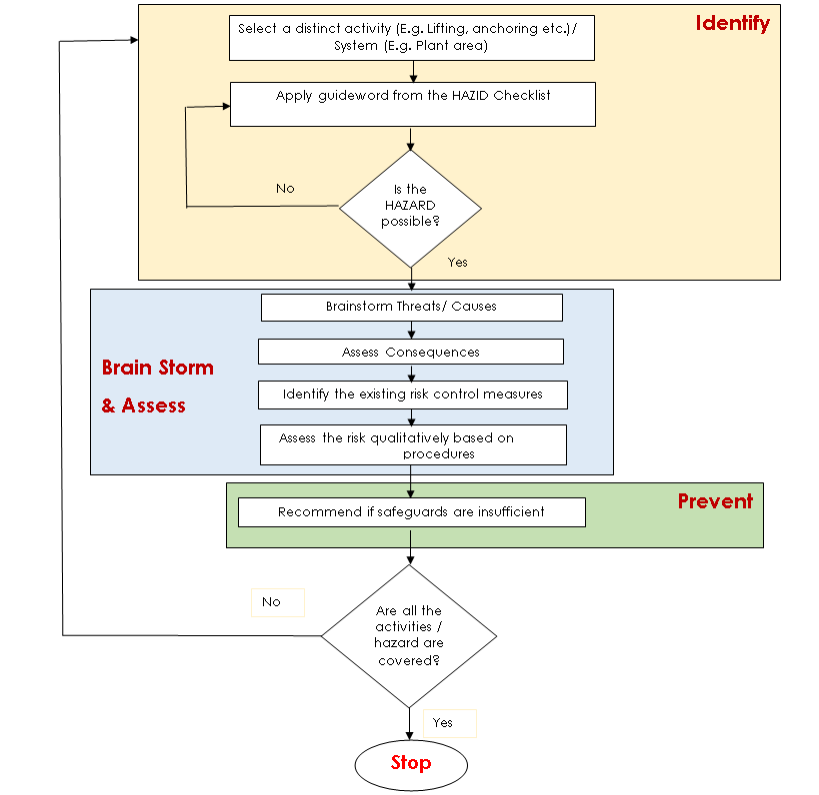
The step-wise procedure in conducting HAZID is presented below.
- Divide the Project into distinct activities;
- Select a particular activity;
- Apply the Guidewords from the HAZID checklist on the selected activity for all systems
- If the hazard is possible continue or apply another guideword
- Brainstorm the causes for the hazards
- Evaluate the consequences
- Identify Safeguards to control / mitigate the hazards
- Qualitatively assess the risk using a COMPANY risk matrix.
- Recommend, if the safeguards are not sufficient.
Key distinctive characteristics of HAZID Study:
- Early-Stage, Design-Focused Hazard Identification – The study was carried out as a structured, early-phase HAZID to identify credible major hazards associated with LNG/LCNG storage, pumping, vaporization, and transfer systems before escalation into higher-risk scenarios.
- Comprehensive Hazard Coverage Beyond Process Risks – The HAZID uniquely covered a wide range of hazard categories including equipment integrity, utility failures, external impacts, human factors, maintenance practices, emergency resources, and spill response, providing a holistic risk perspective.
- Standards-Aligned, Software-Based Assessment – The study followed CCPS risk assessment guidelines and was documented using PHA-Pro v8 software, ensuring traceability, consistency, and defensible risk ranking.
- Risk Ranking With and Without Recommendations – Risks were evaluated both with existing safeguards and after implementation of recommendations, clearly demonstrating risk reduction to ALARP/Low levels
- Following are the hazards which have been assessed during the Study
- General Hazards
- Facility Equipment
- Geo-hazards
- Equipment Integrity
- Chemicals
- External Impact
- Natural hazard
- Man-Made hazard
- Planning, procedure and Contingencies
- Utility failure
- Human factors
- Equipment layout
- Resources-People
- Maintenance and Integrity management
- Procedure and Documentation
- Natural and Environmental
- Emergency Resources
- Spill Response
- Key Outcomes
- Identification of Credible Major Hazards – The study identified credible hazard scenarios associated with LNG unloading, cryogenic storage, pumping, vaporization, LCNG compression, and associated utilities, covering normal and abnormal operating conditions.
- Risk Reduction to ALARP Levels – Qualitative risk ranking demonstrated that, with existing safeguards and implementation of identified recommendations, all evaluated risks can be reduced to ALARP or Low risk levels.
- Focused, Actionable Recommendations – Risk-based recommendations were developed, primarily addressing inspection, testing, preventive maintenance, utility reliability, and operational controls.
- Strengthened Basis for Safe and Compliant Operations – The outcomes provide a structured foundation for enhancing equipment integrity, emergency preparedness, and operational discipline, supporting safe, reliable, and regulatory-compliant operation of the LCNG facility.
- Conclusion
The Hazard Identification (HAZID) study concluded that the LCNG station at Porbandar is designed with appropriate safeguards to manage the identified operational, equipment, and external hazards associated with LNG and LCNG facilities. The study systematically identified credible hazard scenarios and evaluated existing controls, demonstrating that risks can be maintained within ALARP or Low levels through effective implementation of the recommended measures. Overall, the HAZID highlights the importance of early-stage hazard identification, multidisciplinary participation, and timely closure of recommendations in achieving safe, reliable, and regulatory-compliant operation of the LCNG station.