

Vent Dispersion Case Study – Was it Gas Plant, Saudi Aramco
Project Number: 22.609.48.01-kent-sa-gd
Gas Dispersion Serial No.: 01
- Project Overview
A Vent and Flare Dispersion Study was conducted for the Upgrade of MEG Recovery Units at the Wasit Gas Plant, Saudi Aramco, to evaluate the dispersion behavior of flammable and toxic gases released from atmospheric vents of new equipment and from the existing LP/AG flare stack under normal and abnormal operating conditions. The study was performed to assess the potential impact of gas dispersion on manned areas and platforms within the facility, considering both ground-level and downwind concentrations.
The study involved detailed review of critical project documents including Piping and Instrumentation Diagrams (P&IDs), Process Flow Diagrams (PFDs), Heat and Material Balance data, site layout, vent and flare configuration, meteorological conditions, and approved assumption registers. Dispersion modeling was carried out using PHAST (DNV) software, providing a quantitative basis to support safe design decisions, confirm adequacy of existing venting arrangements, and maintain safe and reliable operation of the upgraded MEG recovery units
- Objective
The objective of the study was to determine whether releases from vents and cold venting scenarios from the flare stack could result in flammable or toxic gas concentrations exceeding specified criteria (LFL, 0.5 LFL, 0.1 LFL, IDLH) at occupied locations, and to verify the adequacy of vent and flare stack heights for safe dispersion. Given the nature of hydrocarbons and H₂S handled at the facility, Saudi Aramco emphasizes dispersion assessment as a key element of process safety and regulatory compliance to ensure personnel safety and safe plant operation.
- Methodology
Study Preparation
Prior to the modelling and Simulation for the Study, all the relevant and essential data was requested and Upon receipt of the data, the study team analysed the adequacy of the data and prepared assumptions register. This Assumption Register lists down all the essential parameters and assumptions that were used in the consequence modelling.
Vent Dispersion Methodology
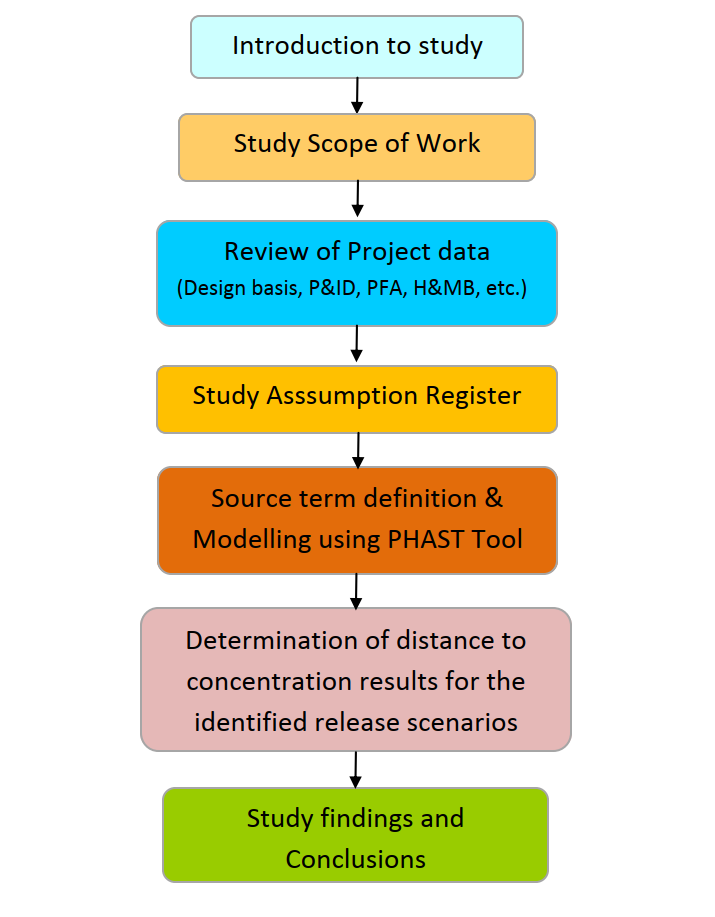
The vent and flare dispersion study was carried out using a structured methodology comprising the following steps:
- Submission of Assumption Register and approval
- Identification of potential release points, including atmospheric vents and the flare stack.
- Collection and review of relevant project information such as project scope definition, Piping and Instrumentation Diagrams (P&IDs), Process Flow Diagrams (PFDs), and Heat and Material Balance data.
- Definition of source terms and compilation of process parameters for the identified release scenarios.
- Evaluation of site-specific meteorological data and selection of appropriate wind speed and atmospheric stability classes.
- Dispersion modelling and consequence analysis of identified release scenarios using the PHAST software.
- Extraction and interpretation of dispersion results for flammable and toxic concentration thresholds.
- Analysis of study findings and formulation of conclusions.
- Preparation of the study report and supporting documentation.
Key distinctive characteristics of Vent Dispersion Study:
- Project-Specific, Design-Verification Focus – The study was conducted specifically to verify the adequacy of atmospheric vent and flare stack heights for the upgraded MEG Recovery Units, ensuring safe dispersion under normal venting and abnormal (cold venting/flame-out) conditions.
- Quantitative Dispersion Modeling Using PHAST – Dispersion analysis was performed using PHAST (DNV) software, employing validated consequence models based on TNO Yellow Book methodologies for realistic prediction of flammable and toxic gas dispersion behavior.
- Evaluation of Both Flammable and Toxic Impacts – The study uniquely assessed dispersion against multiple criteria including LFL, 0.5 LFL, 0.1 LFL for flammable gases and IDLH / 0.5 IDLH for toxic gases (H₂S), covering a wide spectrum of credible safety impacts.
- Meteorology and Assumption-Driven Assessment – Site-specific meteorological conditions, atmospheric stability classes, and a formally approved assumption register were used as the basis for modeling, ensuring transparency, repeatability, and regulatory defensibility of results.
- Clear, Decision-Oriented Outcomes – Results were presented through downwind distance tables and side-view dispersion plots, clearly demonstrating that flammable and toxic gas concentrations do not reach ground level, thereby supporting safe design and operational acceptance.
- Key Outcomes
- Verification of Safe Dispersion from Atmospheric Vents – Dispersion modeling demonstrated that flammable gas releases from the MEG Reclaimer Condenser atmospheric vent do not reach ground level at LFL, 0.5 LFL, or 0.1 LFL concentrations under all assessed meteorological conditions.
- Adequacy of Flare Stack Height Confirmed – Analysis of cold venting scenarios from the existing LP/AG flare stack confirmed that flammable and toxic gas concentrations remain elevated and do not impact ground-level or manned areas, even during flame-out conditions.
- No Toxic Exposure Risk to Personnel – Toxic gas (H₂S) dispersion results showed that IDLH and 0.5 IDLH concentration thresholds are not reached at ground level, indicating no credible toxic exposure risk to personnel within the facility.
- Compliance with Design and Safety Criteria – The study confirmed that the existing vent and flare configurations meet project safety objectives and applicable design practices, eliminating the need for additional mitigation measures related to dispersion.
- Support for Safe and Reliable Plant Operation – The results provide a quantitative basis to support continued operation and upgrade of the MEG Recovery Units, ensuring personnel safety, regulatory compliance, and safe integration of new equipment.
- Conclusion
The Vent and Flare Dispersion Study concluded that the atmospheric vents and existing LP/AG flare stack associated with the upgraded MEG Recovery Units at the Wasit Gas Plant are designed with adequate provisions to ensure safe dispersion of flammable and toxic gases. The study systematically evaluated credible venting and cold venting scenarios using quantitative dispersion modeling and demonstrated that flammable and toxic gas concentrations do not reach ground level or impact manned areas, thereby maintaining risks within acceptable limits. Overall, the study highlights the importance of systematic dispersion assessment, consideration of site-specific meteorological conditions, and verification of vent and flare configurations in achieving safe, reliable, and regulatory-compliant plant operation.