
HAZID Case Study – UBL Group
Project Number: 21-542.01_05.236_35-ubl-mpl-hazop_hazid
HAZID Serial No: 35
- Project Overview
A Hazard Identification (HAZID) Study was conducted for the project facilities at United Breweries Limited Group, across multiple locations in India to systematically identify potential hazards associated with process operations, materials handled, equipment, and site activities during normal and abnormal operating conditions. The objective of the study was to identify credible hazard scenarios at an early stage of the project and to evaluate their potential impacts on personnel, plant, environment, and surrounding areas, thereby enabling timely risk reduction.
The study involved a structured review of key project information including process descriptions, layout drawings, Piping and Instrumentation Diagrams (P&IDs), Material Safety Data Sheets (MSDS), Standard Operating Procedures (SOPs), and hazardous area classification information. A multidisciplinary team carried out a qualitative assessment of hazards, potential causes, consequences, and existing safeguards, and identified recommendations to eliminate or mitigate risks. The HAZID provides a high-level, systematic basis for early hazard management, supporting safer design decisions, regulatory compliance, and reliable operation of the facility.
- Objective
To identify potential hazards associated with processes, equipment, materials, and site activities at an early stage and assess their possible impacts on personnel, plant, and environment.
To identify existing safeguards and recommend risk reduction measures to support safer design, regulatory compliance, and reliable operation of the facility.
- Methodology
HAZID is a workshop-based study which involves brainstorming among team of subject experts led by the experienced Facilitator and guided by a set of process deviations. The procedure for HAZID study is shown in the schematic below:
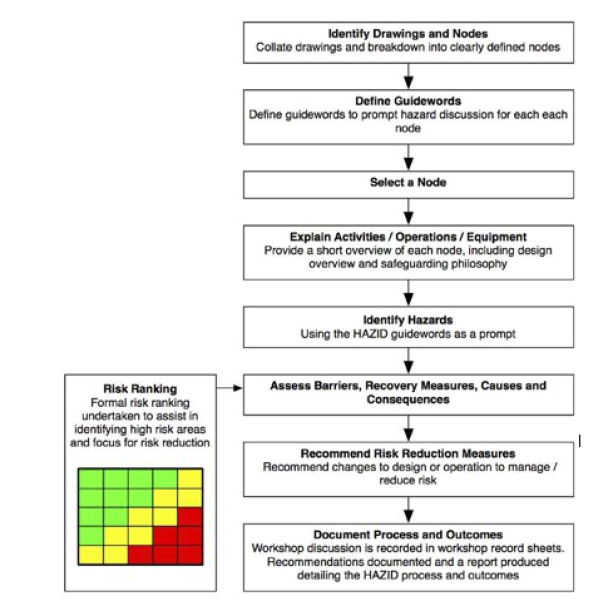
Figure 1: Schematic of HAZID Study
The procedure shown above is briefed in following points.
- Before commencement of the workshop, Chairman Shall Select the appropriate section/area of the plant
- The list of nodes, details of workshop venue, composition of study team, detailed workshop schedule etc. shall be compiled together to prepare a Terms of Reference (ToR) for HAZID study workshop. The ToR document shall be circulated with all the study team members.
- The workshop study should start with an opening statement by the study facilitator. The opening statement shall address the following agenda as minimum:
- Objectives of the study
- Brief study methodology
- List of nodes to be subjected to workshop
- List of guidewords (Refer Appendix-A for list of Guidewords)
- Format of HAZID worksheet (Refer Appendix-C or format of HAZID worksheet)
- Once it is ensured that all team members understand the methodology the facilitator shall Select the appropriate section/area of the plant.
- Define the design intent of the area.
- Select the first/next Hazard Category.
- Apply the first/next guide word, which when combined with the Hazard Category will give the hazard scenarios.
- Determine (by brainstorming) all the potential Likely Threat/ causes of the hazards.
- Agree on the credibility of each Likely Threat/cause.
- Assess the Top Event/consequences of each Likely Threat/cause; assess the protection and the prevention provided against the Likely Threat/causes and its Top Event/consequences.
- Assess the likelihood of each hazard.
- Assign a risk level for each hazard. Standard Controls in place and all safeguards considered in the design shall be accounted while assigning the risk level.
- Agree on a recommendation for action or further consideration of the problem (if applicable).
- Apply the next guide word (relevant to the selected Hazard Category).
- Apply the next Hazard Category until they have all been considered.
- Switch to the next area of the plant /project until the whole study area has been examined.
- The facilitator shall select and apply the Guidewords (Refer Appendix-A for list of Guidewords) for the selected node.
- sample video recording of the existing traffic flow
- Interview with local operations management team to understand the genesis of all recorded incidents.
- Data Collection for Parking Requirement
Key distinctive characteristics of HAZID Study:
- Traffic-Focused, HAZID-Based Approach – The study uniquely applied the HAZID methodology to vehicle–man–machine interactions, with specific focus on in-plant traffic movement, forklift operations, and pedestrian safety rather than only process hazards.
- Workshop-Driven, Multidisciplinary Assessment – The HAZID was conducted through structured workshops involving operations, safety, and management personnel, led by experienced facilitators using defined guidewords and risk matrices.
- Comprehensive Site-Specific Evaluation – The study included site walkthroughs, mapping of vehicle and pedestrian routes, identification of blind spots, review of past incidents, and sample video recording of actual traffic flow.
- Standards-Aligned and Risk-Based – The assessment followed IS 15656, CCPS guidelines, and client TOR, with qualitative risk ranking to prioritize hazards and recommendations.
- Structure of Worksheet
- Node
- Design Intent
- Guideword
- Likely Threat (Cause)
- Control in Place (Safeguards)
- Recommendation
- Action Party
- Key Outcomes
- Identification of Critical Traffic and Man–Machine Hazards – The study identified multiple credible scenarios involving vehicle–pedestrian interaction, blind spots, reversing operations, and congestion that could lead to injury or asset damage.
- Development of Structured, Actionable Recommendations – A comprehensive set of recommendations was generated covering engineering controls (barricading, mirrors, humps), administrative controls (SOPs, permits), and training requirements.
- Improved Basis for Traffic Segregation and Layout Optimization – The outcomes support implementation of effective man–machine segregation, improved road layouts, pedestrian walkways, parking arrangements, and traffic control infrastructure.
- Enhanced Safety and Compliance Framework – The study establishes a clear roadmap to reduce traffic-related incidents, strengthen emergency response, and improve overall safety culture while aligning with statutory and best-practice requirements.
- Conclusion
The Hazard Identification (HAZID) study concluded that the facility has established systems and controls to manage operational and traffic-related hazards associated with man, machine, and vehicle interactions. Implementation of the identified recommendations will further reduce the likelihood and consequences of incidents arising from unsafe traffic movement, blind spots, and interface hazards, and will enhance pedestrian safety, traffic segregation, and emergency response effectiveness. Overall, the study highlights the importance of early-stage hazard identification, multidisciplinary participation, and systematic implementation of recommendations in achieving safe, reliable, and compliant plant operations.