
What-If Analysis Case Study – Gujarat Fluorochemicals Ltd., Dahej
Project Number: 26-783.61.001-gfl-dhj-wia-FRD-902
What-If Study Serial No.: 01
- Project Overview
A What-If Analysis Study was conducted for the pilot plant operations involving FRD-902 trials at Pilot Plant, Gujarat Fluorochemicals Limited (GFL), Dahej.
The study aimed to systematically identify potential hazards and operability issues associated with pilot-scale batch processing involving acetonitrile, TMU catalyst, and HFPO gas in an autoclave system. The assessment covered the complete process lifecycle including charging, inerting, chilling, reaction, sampling, and product handling.
The What-If methodology was applied through a structured brainstorming session involving a multidisciplinary team to evaluate deviations, human errors, and equipment failures, along with existing safeguards and improvement opportunities.
- Objective
- To identify potential hazards and operability issues in pilot plant trials
- To evaluate risks arising from process deviations, equipment failure, and human error
- To assess adequacy of existing safeguards
- To recommend measures for enhancing process safety and operability
- To support safe scale-up and pilot plant operations
- Methodology
What-If Concept
A What-If Analysis is a qualitative evaluation technique used to examine how changes in assumptions, operating conditions, or system behavior can influence projected performance or outcomes. The method involves exploring alternative scenarios by asking structured “what if” questions and assessing their potential impacts under varying conditions.
What-If Process
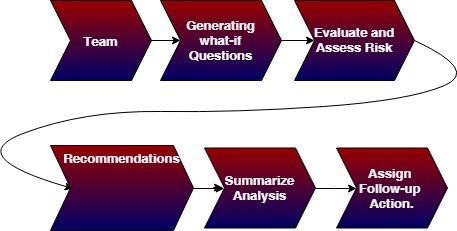
A What-If Study is a high-level, systematic hazard identification technique used to evaluate the response of a process or system to equipment failures, human errors, and abnormal operating conditions. The study is conducted by a multidisciplinary team with knowledge of the process, its operation, and associated hazards. A facilitator guides the team in developing structured “what if” questions (for example, “What if the pressure relief valve fails to operate as intended?”). By discussing and answering these questions, the team identifies potential hazards, existing safeguards, and opportunities for safety improvement. The outcomes of the study are documented in terms of questions raised, identified consequences, and recommended actions.
What-If Steps
The team develops “what if” questions for each process step, operating activity, or equipment component to identify potential sources of failure or error. Key aspects considered during question development include:
- Human errors
- Equipment or component failures
- Deviations from intended operating parameters such as temperature, pressure, flow rate, or time
Examples of typical What-If questions include:
- What if the material concentration is higher or lower than intended?
- What if a valve fails to open or close?
- What if valves are operated in the wrong sequence?
- What if inert gas is not introduced as required?
- What if incompatible materials are inadvertently mixed?
- What if critical readings are missed or ignored?
- What if alarms or warnings are overlooked?
- What if incorrect diagnosis or decision-making occurs?
- Key Distinctive Characteristics
- Pilot Plant Focused Risk Assessment – Addressing scale-up and experimental operations
- Structured What-If Technique – Systematic identification of deviations and failures
- Comprehensive Process Coverage – End-to-end evaluation from charging to product handling
- Integration with SOP and BMR Systems – Alignment with operational controls
- Risk-Based Prioritization – Evaluation before and after recommendations
- Key Outcomes
- Comprehensive Identification of Process Deviations across all pilot plant steps
- Improved Visibility of Operational and Safety Risks including inerting, charging, and temperature control
- Strong Alignment with Existing SOPs and BMR Controls
- Structured Recommendations Developed to enhance safety and operability
- Risk Reduction Achieved Through Implementation of Recommendations
- Conclusion
The What-If Analysis for FRD-902 pilot plant trials provided a systematic evaluation of potential hazards and operability challenges associated with experimental batch processing. The study successfully identified key risk scenarios and assessed the effectiveness of existing safeguards.
The findings highlight the importance of structured SOPs, proper inerting, temperature control, and operational discipline in ensuring safe pilot plant operations. Implementation of the recommendations will enhance process safety, improve operational reliability, and support safe scale-up of the process.