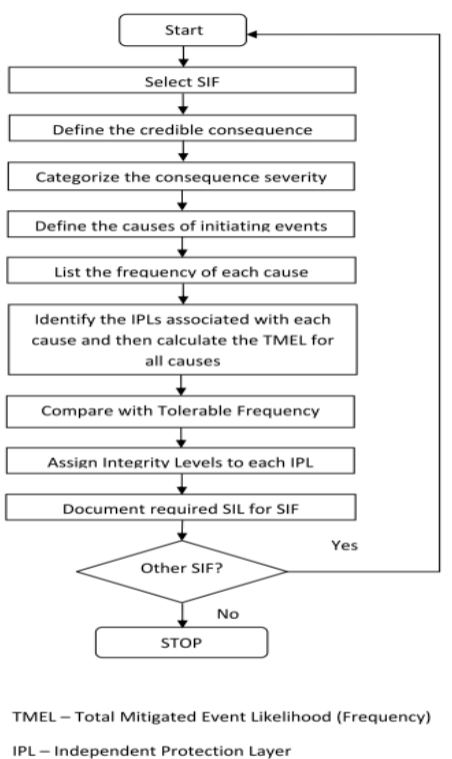
Client Overview: HSE Risk Management Services (HSE-RMS) was engaged to provide scribing support for the Safety Integrity Level (SIL) Study of the Sulphur Block Process Unit (SBPU) at Kuwait Gulf Oil Company (KGOC). The objective was to ensure systematic, accurate, and standards-compliant documentation of all HAZOP proceedings, including deviations, risks, and recommendations to enhance process safety and operability.
Process Technology Overview: The Sulphur Block Process Unit (SBPU) at KGOC is based on Shell licensed technology. The unit comprises three major sections:
- Acid Gas Enrichment Unit (AGEU) – Enhances H₂S concentration in acid gas streams for efficient downstream processing
- Sulphur Recovery Unit (SRU) – Converts hydrogen sulfide (H₂S) into elemental sulfur using the Claus process
- Tail Gas Treating Unit (TGTU) – Treats residual gases to minimize sulfur emissions and meet environmental standards
SIL Concept Overview: A SIL Assessment Study is a structured evaluation process used to:
- Identify potential hazardous events
- Define Safety Instrumented Functions (SIFs)
- Determine the required level of risk reduction
The SIL study aimed to evaluate hazardous scenarios and determine the required Safety Integrity Levels (SILs) for Safety Instrumented Functions (SIFs), ensuring adequate risk reduction and compliance with safety requirements.
The SIL represents the reliability required from a Safety Instrumented System (SIS) to mitigate identified risks.
SIL determination is based on:
- Likelihood of hazardous event occurrence (without SIF)
- Severity of consequences:
- Personnel Safety (S)
- Environmental Impact (E)
- Asset/Economic Loss (P)
- Reputation Impact (R)
Objectives of SIL Study
- Establish study basis and applicable standards
- Identify all Safety Instrumented Functions (SIFs)
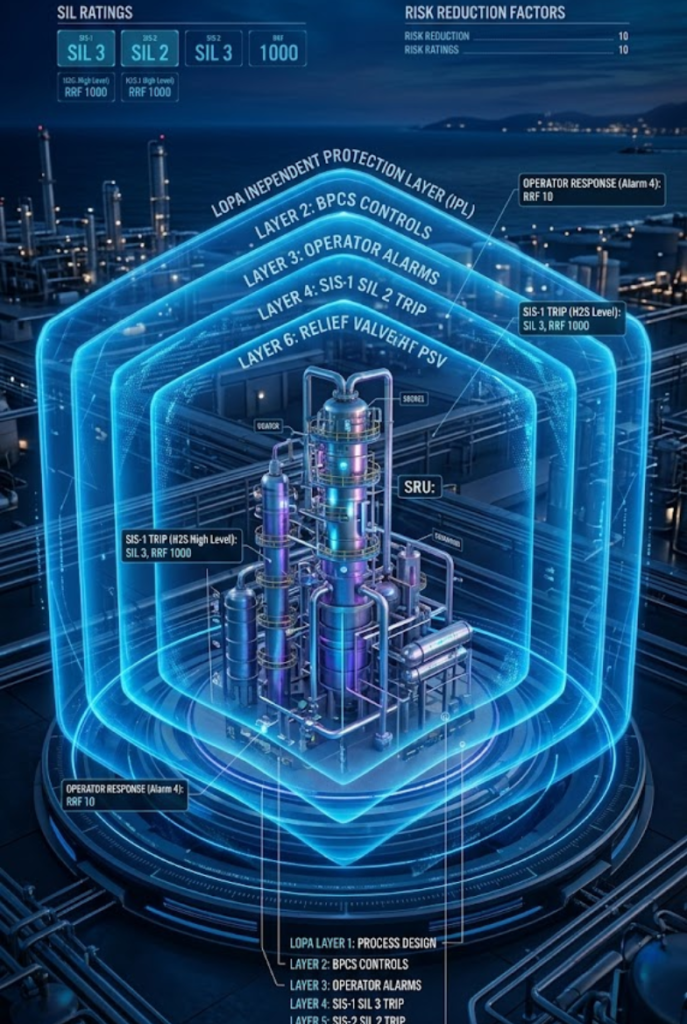
- Define causes, consequences, and IPLs
- Evaluate Probability of Failure on Demand (PFD)
- Determine Risk Reduction Factor (RRF) and SIL levels
- Record recommendations and action items
SIL Study Methodology: The study was conducted using Layer of Protection Analysis (LOPA) methodology, aligned with:
- KOC Recommended Practice for SIF (KOC-I-017)
- International standards: IEC 61508 and IEC 61511
Each scenario was analyzed considering:
- Initiating events
- Enabling conditions
- Existing Independent Protection Layers (IPLs)
- Risk ranking and tolerability criteria