What is LOPA?
Layer of Protection Analysis (LOPA) is a simplified and quantitative form of risk assessment used to evaluate whether there are sufficient independent protection layers exist to reduce risk to an acceptable level. LOPA is generally based on the information developed during Process Hazard Analysis (PHA) techniques such as HAZOP to verify if there are adequate independent protection layers available for high risk scenarios identified.
LOPA typically uses order-of-magnitude categories for:
- Initiating event frequency
- Consequence severity
- Likelihood of failure of Independent Protection Layers (IPLs)
to approximate the risk of a scenario.
Purpose of LOPA
The main objectives of a LOPA study are:
- LOPA identifies the requirements of Safety Instrumented Functions (SIFs).
- LOPA helps to reduce risks to As Low As Reasonably Practicable (ALARP).
- LOPA evaluates the adequacy of existing independent protection layers.
- LOPA also determines whether additional risk reduction measures are required.
LOPA studies are generally carried out using information from Process Hazard Analysis (PHA) techniques such as HAZOP. LOPA team comprises of the following :
- Operations
- Process/Projects
- Instrumentation
- Electrical
- Mechanical
- Other relevant disciplines
This multi-disciplinary team ensure a comprehensive assessment.
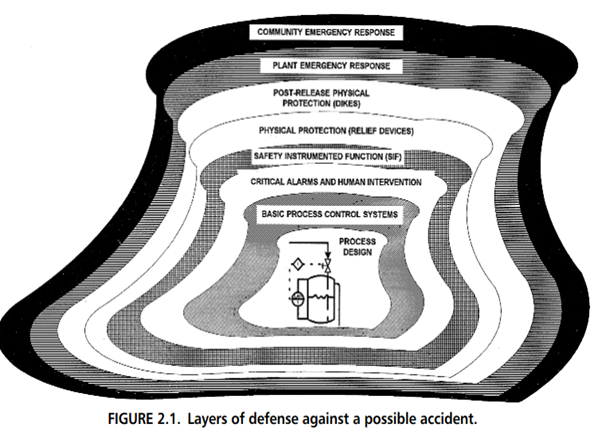
Layers of Defence
A process may contain several layers of protection designed to prevent an incident or reduce its consequences.
A scenario may require one or more protection layers depending on Complexity of the process and Potential severity of the consequence
These independent layers work together as defences against a possible accident and prevent it from happening.
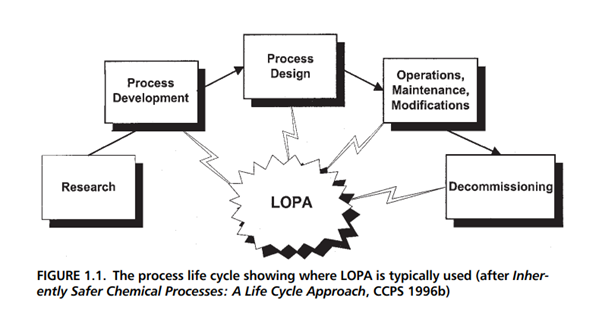
Use of LOPA in the Process Life Cycle
LOPA can be effectively applied at any stage of a process or facility life cycle. However, it is most commonly used during the design stage of the facility when the Process Flow Diagrams (PFDs) and Piping and Instrumentation Diagrams (P&IDs) are essentially complete along with instrumentation, controlling and safeguarding philosophy.
LOPA is used for the following:
- Examining high risk scenarios identified during HAZOP, What-If, Checklist, and other PHA techniques.
- Support Safety Instrumented Function (SIF) design.
- Compare process alternatives and select the preferred option.
LOPA can be applied when modifications are made to existing processes, control systems and safety systems to ensure that the risks remain acceptable.
Additional Applications of LOPA
LOPA can also be used to:
- Evaluate the conceptual process designs.
- Comparison of design alternatives.
- Identification of options with lower initiating event frequencies.
- Identification of alternatives with reduced consequences.
- Evaluate the adequacy of Independent Protection Layers.
- Determine whether the risks involved in the process are tolerable.
- Determine the required Safety Integrity Level (SIL) when a Safety Instrumented Function is needed.
- Identification of operator actions and its responses that are critical to safety of the process.
LOPA Methodology
A typical LOPA study follows the following steps:
Step 1: Identify the consequence and screen the scenarios which needs to be assessed in LOPA.
Step 2: Select an accident scenario.
Step 3: Identify the initiating event of the scenario and determine the initiating event frequency (events per year).
Step 4: Identify the Independent Protection Layers (IPLs) and estimate the Probability of Failure on Demand (PFD) of each IPL.
Step 5: Estimate the risk of the scenario by combining the consequence data, initiating event frequency, conditional modifiers, enabling conditions and PFDs of all the IPLs to determine the overall risk level.
Benefits of LOPA
LOPA offers several advantages as following:
- It is a quantitative technique which requires less time than a Quantitative Risk Assessment (QRA).
- It provides a simplified and consistent framework for risk estimation for any process.
- It also helps in resolving conflicts in decision-making regarding risk.
- LOPA improves identification of cause–consequence pairs.
- It also allows comparison of risks between units or facilities.
- LOPA supports demonstration that risk is As Low As Reasonably Practicable (ALARP).
- LOPA also assists in meeting regulatory requirements.
- It identifies scenarios where existing safeguards may not provide sufficient risk reduction.
- It helps in determining whether additional safeguards are required or not.