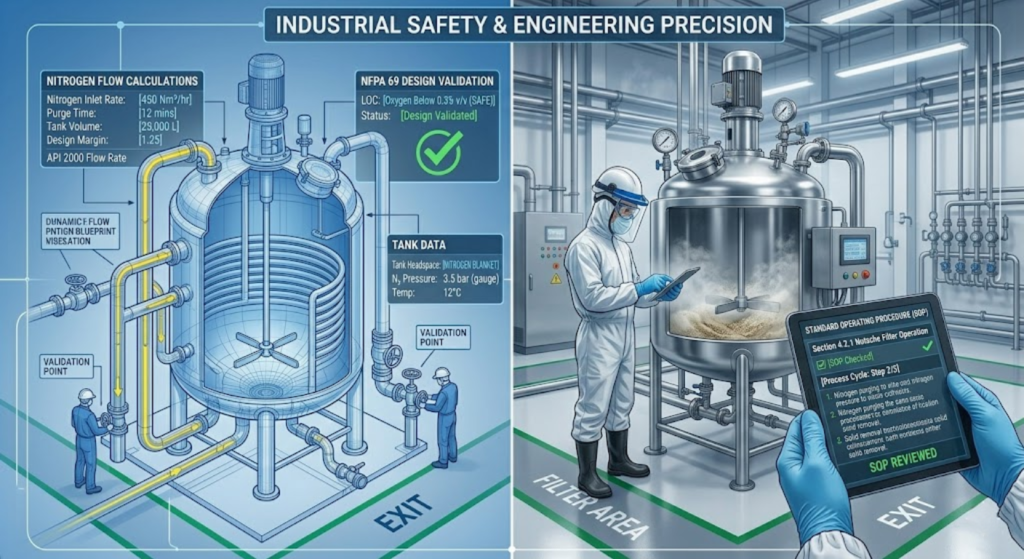
N₂ Inertization & Validation Case Study – Tagros Chemicals, Cuddalore
Project Number: 24-713.54.01-tgcipl-cot-ni
Nitrogen (N₂) Inertization Study No.: 02
- Project Overview
An N₂ Inertization and Validation Study was conducted for process vessels including reactors, agitated nutsche filters, and dryers at Tagros Chemicals India Pvt. Limited, Cuddalore, Tamil Nadu.
The study focused on ensuring safe handling of flammable chemicals by maintaining oxygen concentration below the limiting oxygen concentration (LOC). In addition to calculating nitrogen requirements, the study validated existing Standard Operating Procedures (SOPs) to ensure effective implementation of inertization practices across process stages.
The assessment was carried out in line with NFPA 69 guidelines and included both design validation and operational (SOP) validation.
- Objective
- To evaluate nitrogen inertization requirements for process vessels
- To validate SOPs for safe inertization practices
- To ensure oxygen levels remain below LOC during operations
- To assess adequacy of nitrogen generation and supply system
- To enhance process safety through validated operational controls.
- Methodology
Study Approach
The study was conducted in two key parts:
Design Validation
- Calculation of nitrogen requirement for all process units
- Evaluation of simultaneous plant operation scenarios
- Verification of nitrogen generation capacity vs demand
- Assessment of system adequacy under peak conditions
Validation Procedure For N2 Inertization
N2 inertization is required in 3 steps
I. N2 inertization in vessel before transferring/charging of 1st flammable chemical.
II. N2 inertization in vessel during the process (reaction/unit operation) in the vessel.
III. N2 inertization in vessel during empty out.
Validation Procedure No. “A”: N₂ inertization in vessel before transferring/charging of 1st flammable chemical
- Volume of N₂ required for inerting the vessel before transferring/charging of 1st flammable chemical is provided in “Design validation” under “Annexure-I”. (Refer Column-G)
- Flow rate of nitrogen to vessel should be fixed through orifice of appropriate size. Flowrate can be measured through a flowmeter installed in N₂ line to equipment.
- Formula for Time required for nitrogen inertization in the equipment = (Volume of the reactor / Flowrate of nitrogen)
- Provide nitrogen flow to vessel for the time calculated as per step 3.
- Measure the oxygen level at the bottom of reactor (1st cycle).
- If the oxygen concentration is above required LOC, repeat the 4th step and measure the oxygen concentration at the bottom of reactor till oxygen level reaches equal to or below required LOC (2nd and 3rd Cycle).
- Initially, validate number of cycles needed of inerting in Step 6.
- Perform Step 4 to 7 three times.
- Frequency of validation should be every six months or if there is any major maintenance of equipment/vessel entries/maintenance of connected piping/dish-ends/valves etc. to equipment.
Validation Procedure No. “B”: N₂ inertization in vessel during the process
- Once the vessel is inertized as per Validation Procedure No. A, fill the vessel with process fluid and keep the vessel inertized with the help of nitrogen at a pressure 100 mm water column above the operating pressure.
- After every 1 hour, record the oxygen level at the top of vessel for up to 3 hours.
- If oxygen level is above LOC, increase the pressure to 200 mm water column and record the oxygen level at the bottom of vessel after every 1 hour, for up to 3 hours. Increase the pressure by 100 mm water column until two subsequent oxygen level readings are below required LOC.
- Frequency of validation should be every six months or if there is any major maintenance of equipment/vessel entries/maintenance of connected piping/dish-ends/valves etc. to equipment.
Validation Procedure No. “C”: N₂ inertization in vessel during empty out
- After completion of Validation Procedure A and B, empty out the vessel as per SOP of equipment (pump/gravity/vacuum etc.) while keeping the nitrogen supply open through the orifice.
- Calculate the flow of N₂ required during the empty out of the reactor by formula = (Volume of reactor / time required to completely empty the vessel).
- Measure the oxygen level at the bottom of vessel after empty out. The oxygen level should be below the required LOC.
- If oxygen level is above LOC, increase the flow of nitrogen by 5% and measure the oxygen level at the bottom of vessel after empty out.
- Perform steps 1–4 on a test vessel 3 times to validate the process.
- This process shall be reviewed once in six months or if there is any major maintenance of equipment/vessel entries/maintenance of connected piping/dish-ends/valves etc. to equipment.
- Key distinctive characteristics of N₂ Inertization and Validation Study:
- Dual Validation Approach – Integration of design and operational validation
- Process-Wide Coverage – Assessment across reactors, filters, and dryers
- Standards-Based Framework – Aligned with NFPA 69
- SOP-Level Detailing – Equipment-wise inertization validation
- Scenario-Based Evaluation – Covers full lifecycle (charging → processing → emptying)
- Key Outcomes
- Nitrogen System Adequacy Confirmed for simultaneous plant operations
- Structured SOP Validation Framework Established across all process stages
- Alignment with NFPA 69 for inertization and safety practices
- Enhanced Control of Oxygen Levels ensuring safe operating conditions
- Opportunities Identified for Strengthening SOP Implementation.
- Conclusion
The N₂ Inertization and Validation Study demonstrates a comprehensive and integrated approach to process safety by combining engineering design verification with operational validation. The study confirms that the nitrogen system is capable of supporting plant-wide requirements while ensuring effective inertization across all critical stages of operation.
By validating SOPs and establishing a structured inertization framework, the study enhances operational reliability, reduces ignition risk, and strengthens overall process safety performance.