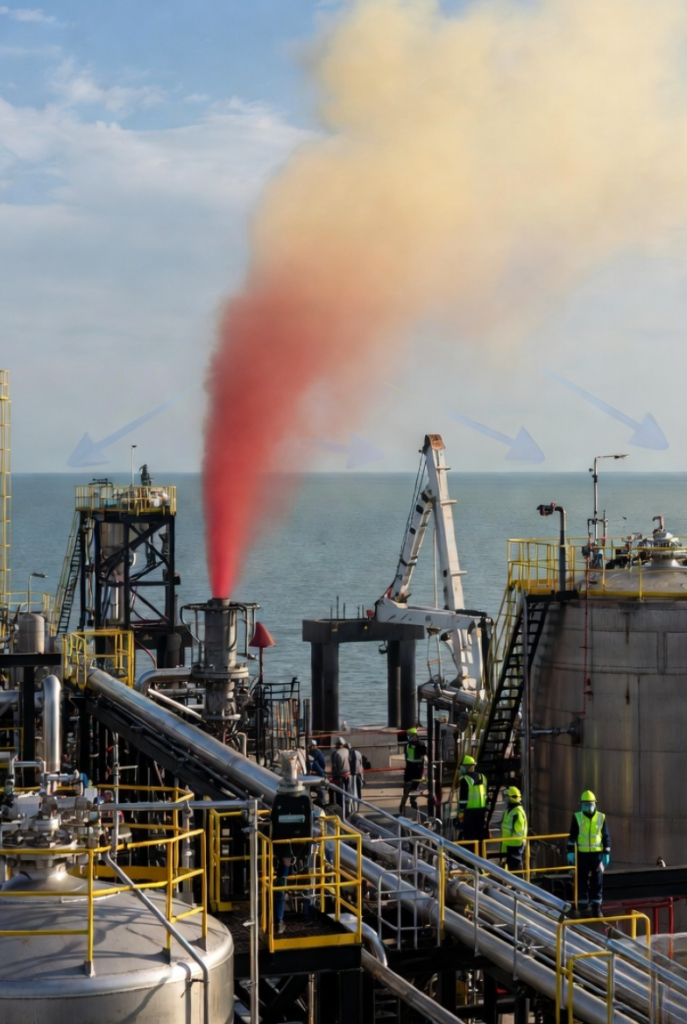
Vent Dispersion Case Study – LPG Terminal, BPCL
Project Number: 24-700.03.21_48.02-stte-bct-qra_gd
Gas Dispersion Serial No.: 02
- Project Overview
A Gas Dispersion Analysis Study was conducted for the Drain Pot Vent Line as part of the Augmentation of Cryogenic Facilities at the LPG Terminal, Uran, Maharashtra, owned by Bharat Petroleum Corporation Limited (BPCL). The study was carried out to assess the dispersion behavior of flammable hydrocarbon vapors released from the Pressure Safety Valve (PSV) installed on the Jetty Drain Pot and to evaluate the potential impact on nearby manned platforms and ground-level areas. The study was performed using quantitative consequence modeling techniques in line with established QRA and dispersion assessment guidelines.
The study involved detailed review of project engineering documents such as Basic Engineering Design Basis, Piping and Instrumentation Diagrams (P&IDs), vent configuration details, material composition data, site layout, and meteorological conditions. Dispersion modeling was performed using PHAST (DNV) software to support verification of vent height adequacy and safe plant operation
- Objective
- To evaluate flammable gas dispersion from the PSV vent in terms of % LFL at ground level and nearby manned platforms under representative meteorological conditions.
- To assess the adequacy of the existing vent height for safe dispersion and evaluate potential thermal radiation impacts in case of ignited releases.
- Methodology
Study Preparation
Prior to the modelling and Simulation for the Study, all the relevant and essential data was requested and Upon receipt of the data, the study team analysed the adequacy of the data and prepared assumptions register. This Assumption Register lists down all the essential parameters and assumptions that were used in the consequence modelling.
Vent Dispersion Methodology
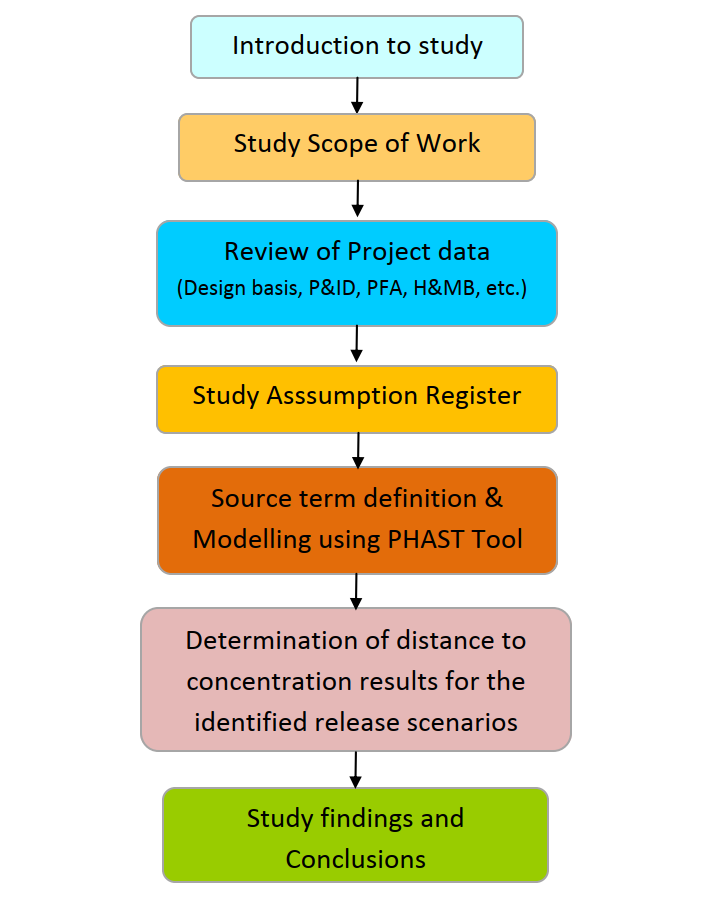
The vent dispersion study was carried out using a structured methodology comprising the following steps:
- Submission of Assumption Register and approval
- Identification of release points (atmospheric vent)
- Gathering of inputs required for initiating the study by reviewing project documents such as basic engineering design basis and P&ID
- Source term definition and collection of process data of identified release points
- Study of meteorological input data and selection of wind speed & stability class.
- Source term modelling and consequence analysis using PHAST for the identified release points
- Extraction of consequence results
- Results analysis, study key findings & conclusions
- Reporting & documentation
Key distinctive characteristics of Vent Dispersion Study:
- PSV-Specific, Jetty-Oriented Assessment – The study uniquely focused on dispersion from a single critical atmospheric vent located on a jetty drain pot, considering proximity to operating platforms and marine assets.
- PHAST-Based Quantitative Modelling – Dispersion and thermal radiation analyses were performed using DNV PHAST, applying Unified Dispersion Model (UDM) and TNO Yellow Book–based consequence methodologies.
- Multiple Weather and Composition Scenarios – The study evaluated dispersion under 1.5F, 3D, and 5D meteorological conditions, considering both maximum propane and maximum butane compositions to represent realistic and conservative cases.
- Formal Assumption Register Approach – All modelling inputs, assumptions, damage criteria, and result presentation formats were documented in a BPCL-approved Assumption Register, ensuring transparency and auditability.
- Key Outcomes
- No Ground-Level or Platform-Level Flammable Impact – Dispersion results confirmed that flammable gas concentrations (LFL and 0.5 LFL) do not reach ground level or nearby operating platforms for all modelled scenarios.
- Vent Height Adequacy Demonstrated – The existing vent height was found to be sufficient for safe dispersion of hydrocarbons released from the PSV under all assessed conditions.
- Thermal Radiation Impact Limited to Assets – Thermal radiation levels of 4 kW/m² and 12.5 kW/m² were observed to potentially affect jetty assets in ignited scenarios, while higher radiation levels (37.5 kW/m²) were not reached.
- No Requirement for Vent Height Modification – Based on dispersion and consequence results, no increase in vent height was required; emphasis was placed on ignition control and firefighting preparedness.
- Conclusion
The Gas Dispersion Analysis Study concluded that the drain pot PSV vent arrangement at the BPCL Uran LPG Terminal is adequately designed to ensure safe dispersion of flammable hydrocarbons under both normal and abnormal operating conditions. Quantitative dispersion modeling demonstrated that flammable gas concentrations do not reach ground level or nearby manned platforms, confirming the adequacy of the existing vent height. While thermal radiation from ignited releases may impact jetty assets, personnel risk remains within acceptable limits when appropriate ignition control and firefighting measures are maintained. Overall, the study highlights the importance of project-specific dispersion assessment, consideration of site meteorology, and verification of venting arrangements in ensuring safe, reliable, and regulatory-compliant terminal operations.