
Project Number: 24-741.03.24-ip-up-qra
QRA Study Serial Number: 24
Project Overview
A Quantitative Risk Assessment (QRA) Study was conducted to assess the risk level due to the CS2 storage tanks, CS2 unloading tanker and associated piping from tanker to Storage tank and Storage Tank to Day Tank at India Pesticides Limited (IPL), Lucknow, Uttar Pradesh, in accordance with Quantitative Risk Assessment CPR 18 E (Purple book), Committee for the prevention of Disaster, Netherlands. The objective was to determine the consequence impact and assess the risk on employees and surrounding public. Given the nature of these chemicals, IPL prioritizes safety to mitigate risks associated with storage and handling, ensuring compliance with regulatory standards while maintaining operational efficiency
The study involved analysis of critical project documents like Piping and Instrumentation diagrams (P&IDs), Site Layout, Site Meteorological conditions, Standard Operating Procedures (SOPs), Inventory Data, Site and Surrounding Demographic Data etc.
- Objective
The objective of the QRA study is to
- Determine the consequence impact due to Carbon Di-Sulphide road tanker, Carbon Di-Sulphide storage tanks and its associated piping
- Assess the risk on employees and surrounding public
- Methodology
QRA Preparation
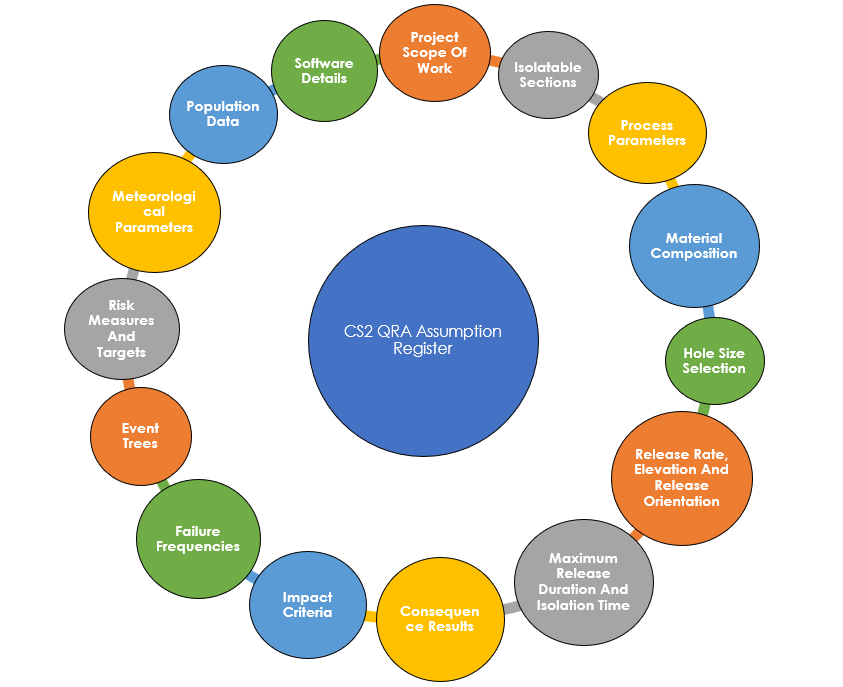
Prior to the modelling and Simulation for the QRA Study, all the relevant and essential data was requested by the HSE-RMS team. Upon receipt of the data, the HSE-RMS team analysed the adequacy of the data and prepared assumptions register. This Assumption Register lists down all the essential parameters and assumptions that were used in the consequence modelling. This Assumption Register was reviewed and approved by IPL team before the consequence modelling. Assumption Register covers the following topic:
QRA Consequence Modelling Session
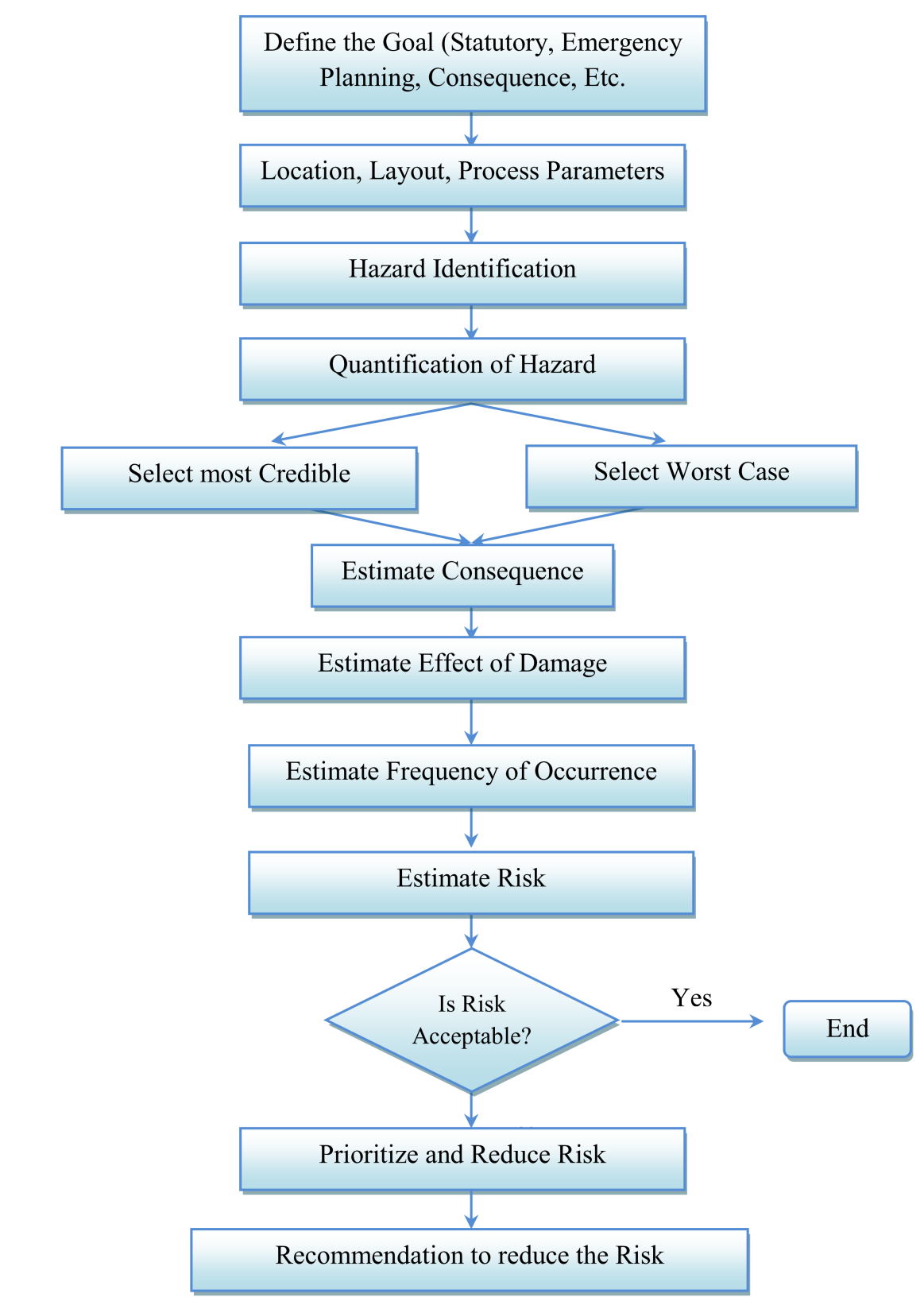
HSE-RMS utilized a structured approach in conducting the QRA:
- Hazard Identification: Identified potential hazards related to the storage and handling of chemicals, considering their properties, storage conditions, and operational practices.
- Risk Assessment: Quantitatively assessed the likelihood and consequences of identified scenarios such as leaks, spills, or fires involving hazardous chemicals using advanced modeling techniques.
- Safety System Evaluation: Evaluated the effectiveness of existing safety systems including fire detection, suppression systems, and emergency response procedures.
- Risk Mitigation Measures: Developed and recommended specific mitigation measures to reduce identified risks to an acceptable level, considering IPL’s operational requirements and safety standards.
The consequence modelling started with model selection in SAFETI software developed by DNV such as pressure vessels, atmospheric storage tanks, pipelines etc. After selection of appropriate models, input parameters such as volume, vessel dimensions, inventory, temperature, pressure, etc. was provided to the software. Also, other parameters such as meteorological conditions were entered.
After input of all the process parameters, demographic data was also provided in the software highlighting populations points both on-site and off-site using satellite image of the facility and surrounding area with scale. The model was made to run with the input data provided and various results such as jet fire, pool fire, flash fire, Boiling Liquid Expanding Vapor Explosion (BLEVE), Gas Dispersion, etc. was extracted from the software for the assessment.
Based on the following criteria the consequence data was assessed and conclusions were made:
- The lethality of a jet fire and pool fire is assumed 100% for the people who are caught in the flame. Outside the flame area, the lethality depends on the heat radiation distances.
- For the flash fires, lethality is taken as 100% for all the people caught outdoors and for 10% who are indoors within the flammable cloud. No fatality is assumed outside the flash fire area.
- Overpressure more than 0.5 bar corresponds approximately with 50% lethality.
- An overpressure above 0.3 bar would result in 10% fatalities.
- An overpressure less than 0.1 bar would not cause any fatalities to the public.
- 100% lethality is assumed for all people who are present within the toxic cloud.
Table 1 : Damages to human life due to heat radiation
| Exposure Duration | Radiation energy (1% lethality), kW/m2 | Radiation energy (2nd degree burns), kW/m2 | Radiation energy (1st degree burns), kW/m2 |
| 10 sec | 21.2 | 16 | 12.5 |
| 30 sec | 9.3 | 7.0 | 4.0 |
Table 2 : Effects due to incident radiation intensity
| Incident Radiation (Kw/m2) | Type of Damage |
| 0.7 | Equivalent to Solar Radiation |
| 4.0 | Sufficient to cause pain within 20 sec. Blistering of skin (first degree burns are likely) |
| 12.5 | Minimum energy required for piloted ignition of wood, melting plastic tubing etc. |
| 37.5 | Heavy Damage to process equipment |
Table 3 : Damage due to overpressures
| Peak Overpressure | Damage Type | Description |
| 0.50 bar | Heavy Damage | Major damage to plant equipment structure |
| 0.30 bar | Moderate Damage | Repairable damage to plant equipment and structure |
| 0.1 bar | Significant Damage | Shattering of glass |
Challenges: Challenges encountered during the QRA process included:
- Ensuring accurate data availability on chemical properties, storage conditions, and operational procedures.
- Coordinating with IPL authorities to ensure compliance with safety standards and regulations.
- Balancing safety enhancements with operational efficiency to minimize disruptions.
Key distinctive characteristics of QRA:
- QRA was carried using SAFETI software developed by DNV which is internationally accepted and followed.
- Guidelines for Quantitative Risk Assessment CPR 18 E (Purple book), Committee for the prevention of Disaster, Netherlands has been used which is widely followed.
- Detailed Consequence Modelling Results were provided which are easy to understand and also Analysis of each of the consequence results were provided.
- Easily understandable Contours, F-N Curve and IRPA results were provided along with their analysis.
- Key Outcomes
- The Individual Risk Per Annum (IRPA) for all equipment and activities within the defined scope (CS₂ tanker, unloading system, storage tanks, and transfer piping) is found to be in the ALARP to Acceptable region.
- Offsite (public)/Societal risk levels are well within the lower ALARP region.
- Catastrophic rupture of the CS₂ road tanker is identified as the worst-case credible scenario, contributing the largest flammable gas dispersion distances, Jet fire radiation impacts and Vapor Cloud Explosion (VCE) overpressure distances, while CS2 Storge tanks posed major pool fire hazard
- Consequence modelling using PHAST demonstrated that:
- Flammable dispersion, VCE, jet fire, and pool fire are the dominant hazardous outcomes.
- Toxic dispersion thresholds (IDLH / ERPG) were found to be not reached to the selected concentration levels in case of selected loss of containment scenarios
- Maximum damage distances occur under stable weather conditions (1.5F).
- Although risks are already within acceptable/ALARP regions, the study recommends additional good-practice measures to further reduce or maintain risk levels.
- Conclusion
The Quantitative Risk Assessment (QRA) study concluded that the risks associated with the CS₂ storage tanks, unloading operations, and associated transfer piping are within acceptable to ALARP limits, considering the identified loss of containment scenarios and the existing engineering, operational, and emergency safeguards. Overall, the study demonstrates the importance of quantitative risk evaluation and inherently safer design principles in ensuring safe, reliable, and compliant operation of CS₂ storage and handling facilities.