

LOPA Study – ZCL Chemicals Limited.
Project Number: 23-674.50.01-zc-akv-hse-lopa
LOPA Serial No: 01
- Project Overview
A Layers of Protection Analysis (LOPA) Study was carried out to evaluate process risk scenarios and to assess the adequacy of existing protection layers associated with critical process interlocks and safety instrumented functions at ZCL Chemicals Limited, Ankleshwar, Gujarat. The study focused on identifying credible hazardous scenarios originating from process deviations and equipment failures, and on assessing whether the existing Independent Protection Layers (IPLs) are sufficient to reduce risks to tolerable levels.
The objective of the LOPA study was to determine the need for Safety Instrumented Functions (SIFs) and to establish the required Safety Integrity Level (SIL), where applicable, in order to achieve risk reduction to As Low As Reasonably Practicable (ALARP) levels. The study was conducted in accordance with IEC 61511 and IEC 61508 standards and followed CCPS guidelines for LOPA methodology. A multidisciplinary team comprising process, operations, instrumentation, electrical, and safety specialists participated in the study.
The LOPA assessment involved review of key project documents including Process and Instrumentation Diagrams (P&IDs), Cause and Effect diagrams, and the HAZOP report. The study provides a structured and semi-quantitative basis for verifying the adequacy of existing safeguards and for defining functional safety requirements, thereby supporting safe, reliable, and regulatory-compliant operation of the plant.
- Objective
The main objectives to:
- Identify risks to Persons, Environment, Assets and Community (Reputation) from potential hazards arising from the failure of Safety Instrumented Functions and associated facilities in the plant.
- Define the basic performance requirements of all Safety Instrumented Functions to reduce the risks to As Low as Reasonably Practical (ALARP).
The Layers of Protection Analysis (LOPA) study was carried out on the Interlocks as identified in the P&IDs that were used during LOPA session along with LOPA assessment team comprising of members knowledgeable in Engineering, Operations, Process, Instrumentation, Electrical, Mechanical and other appropriate specialists.
- Methodology
- SIL Assessment Using LOPA Method
LOPA is a team exercise analyzing hazards and associated risks to determine if SIFs are required and if so, the required Safety Integrity Level (SIL) of each SIF to ensure tolerable risk level is achieved.
SIL Assessment is performed to determine the SIL requirement of a SIF utilizing LOPA technique. It entails evaluating the risk that would be obtained in the absence of the Independent Protection Layer (IPL), the unmitigated risk, and comparing it with the applicable criteria for tolerability of risk. The tolerability of the risk factors has been suggested by the client.
Any shortfall represents the risk reduction that is required of the SIF. Thus LOPA analyzes hazards and associated risks to determine if SIFs are required and, if so; the required safety integrity level (SIL) of each SIF to ensure tolerable risk level is achieved.
The LOPA analysis is performed by a multi-disciplinary team knowledgeable of the design being evaluated and IEC 61508/ 61511 standards. The team shall consist of people qualified to review the chemical processes, identify potential process hazards, and recommend actions be taken to minimize risks.
IPL PFD values are taken from various reliable industry sources like CCPS handbook, team experience and industry data.
|
DEMAND MODE OF OPERATION |
||
|
Safety Integrity Level (SIL) |
Target Average Probability of Failure on Demand (PFDavg) |
Risk Reduction Factor (RRF) |
|
4 |
≥10-5 to < 10-4 |
>10,000 to ≤100,000 |
|
3 |
≥10-4 to <10-3 |
>1000 to ≤10,000 |
|
2 |
≥10-3 to <10-2 |
>100 to ≤1000 |
|
1 |
≥10-2 to <10-1 |
>10 to ≤100 |
- LOPA Method
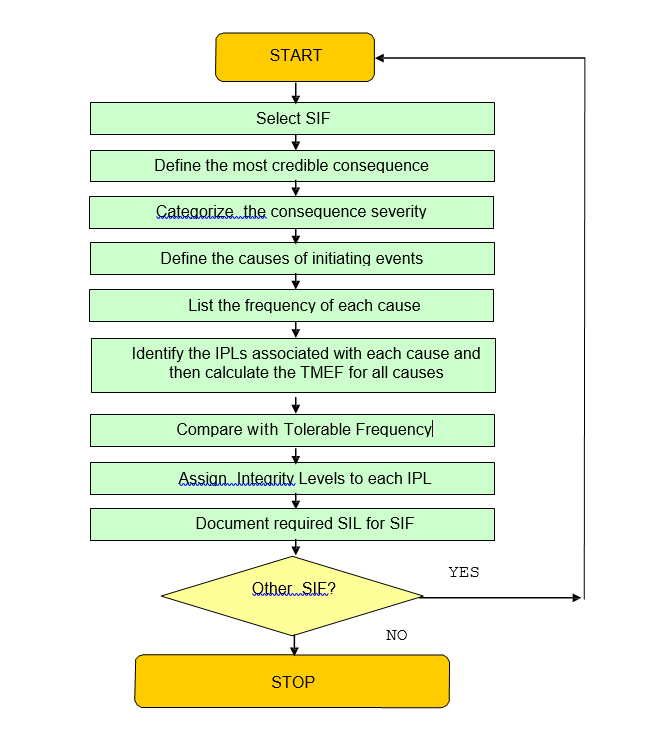
Key distinctive characteristics of LOPA Study:
- Standards-Based Risk Evaluation – The LOPA was conducted in accordance with IEC 61511/61508 and CCPS guidelines, providing a structured, semi-quantitative assessment of process risks and required risk reduction.
- HAZOP-Driven and Documented Approach – The study was directly based on HAZOP findings, P&IDs, and Cause & Effect diagrams, ensuring traceability from hazard identification to risk reduction decisions.
- Rigorous IPL and SIL Assessment – Existing Independent Protection Layers were evaluated for independence and effectiveness, enabling objective determination of Safety Instrumented Function (SIF) and SIL requirements to achieve ALARP risk levels.
- Practical, Expert-Led Outcomes – The multidisciplinary, expert-facilitated study confirmed that most scenarios require no additional SIL safeguards, supporting safe operation while avoiding unnecessary over-engineering
- Key Outcomes
- Validated Risk Tolerability – The LOPA confirmed that identified process risk scenarios are either within tolerable limits or reduced to ALARP through existing protection layers and controls.
- Clear SIL Requirement Determination – The study systematically evaluated Safety Instrumented Functions and established that no additional SIL-rated SIFs are required, with only one scenario identified within the ALARP region.
- Verification of Independent Protection Layers – Existing safeguards were critically assessed and credited as Independent Protection Layers based on independence, effectiveness, and reliability, ensuring defensible risk reduction claims.
- Support for Safe and Reliable Operations – The study provides a robust functional safety basis that supports safe plant operation, regulatory compliance with IEC 61511, and avoidance of unnecessary over-engineering.
- A total of 7 HAZOP scenarios were identified for LOPA Study. Upon LOPA it was identified that no further higher SIL is required
- Conclusion
The Layers of Protection Analysis (LOPA) study concluded that the identified process risk scenarios are adequately addressed through existing engineered, administrative, and operational protection layers, with risks reduced to tolerable or ALARP levels in accordance with IEC 61511 requirements. The study provided a structured and defensible basis for evaluating Independent Protection Layers and determining Safety Instrumented Function and SIL requirements, confirming that no additional SIL-rated safeguards are required for most scenarios. Overall, the LOPA demonstrates the effectiveness of existing safeguards and highlights the importance of systematic, standards-based risk assessment in ensuring safe, reliable, and regulatory-compliant plant operations.