Electrostatic Hazard- Dust Explosion as per NFPA 77

HSE Risk Management Services Pvt. LtdSCO-30 2nd floor Near V.R Mall, TDI Business centre Sector 118, TDI City, Mohali, Punjab-140501Mail id: yashpal@hse-rms.comContact No.: 9012200076, 9012100076, 82880 88030Website: www.hse-rms.comHSE Risk Management Services Pvt. LtdSCO-30 2nd floor Near V.R Mall, TDI Business centre Sector 118, TDI City, Mohali, Punjab-140501Mail id: yashpal@hse-rms.comContact No.: 9012200076, 9012100076, 82880 88030Website: www.hse-rms.comHSE Risk Management Services Pvt. LtdSCO-30 2nd floor Near V.R Mall, TDI Business centre Sector 118, TDI City, Mohali, Punjab-140501Mail id: yashpal@hse-rms.comContact No.: 9012200076, 9012100076, 82880 88030Website: www.hse-rms.comHSE Risk Management Services Pvt. LtdSCO-30 2nd floor Near V.R Mall, TDI Business centre Sector 118, TDI City, Mohali, Punjab-140501Mail id: yashpal@hse-rms.comContact No.: 9012200076, 9012100076, 82880 88030Website: www.hse-rms.com
HSE Risk Management Services Pvt. Ltd
SCO-30 2nd floor Near V.R Mall, TDI Business center Sector 118,
TDI City, Mohali, Punjab-140501
Mail id: yashpal@hse-rms.com
Contact No.: 9012200076, 9012100076, 82880 88030
Website: www.hse-rms.com




|
Client: M/S__ Project: Electrostatic Hazard- Dust Explosion as per NFPA 77 |
||||||
|
|
||||||
|
26/09/2023 |
A |
Draft |
SS |
YSG |
YSG |
|
|
Date |
Rev |
Remarks / Revision Summary |
Prepared |
Checked |
Approved |
Approved By |
|
HSE RMSPL |
Client |
|||||
|
REVISION RECORDS |

- Objective
To identify the conditions required for dust explosion.
- Reference Document/Order of Precedence
- NFPA 77- Recommended Practice on Static Electricity
- IEC 60079 Explosive atmospheres Part 10-2: Classification of areas – Explosive dust atmospheres
- Definitions
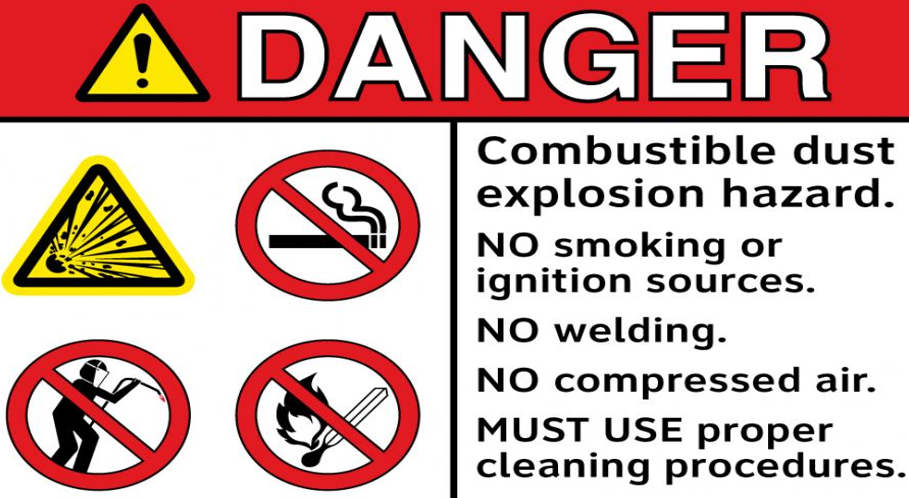
- Combustible Dust- Finely divide solid particles, 420 µm or less in nominal size, which may form an explosive mixture with air at atmospheric pressure and normal temperature.
- Explosive dust atmosphere-Mixture with air, under atmospheric conditions, of flammable substances in the form of dust, which, after ignition, permits self-sustaining propagation
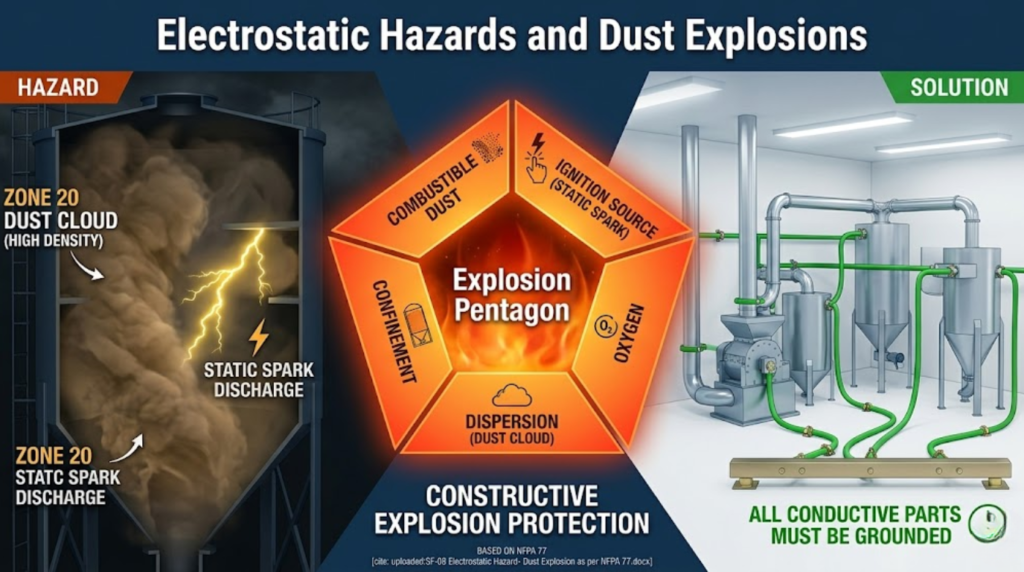
- When do Dust Explosions occur?
When fuel (combustible dust) is dispersed and confined in an enclosed space or building, ignition can result in an explosion.
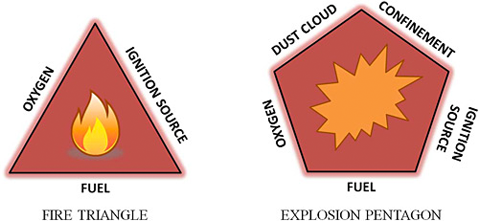
- Explosion Pentagon
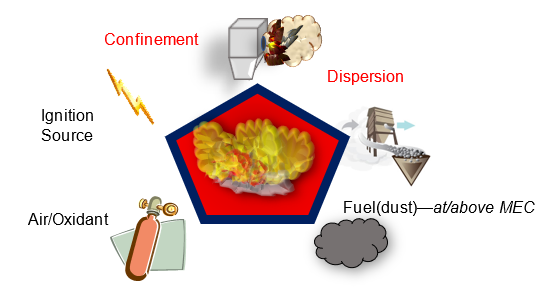
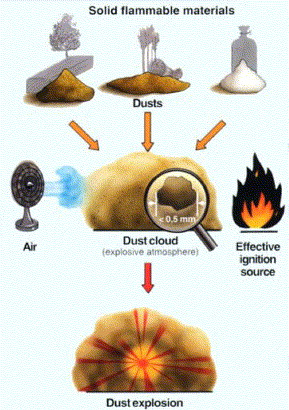
Several factors are required for a dust explosion to happen:
- Combustible dust/Fuel
- Oxygen
- Enclosed space
- Ignition source
- Dispersion
- MIE of Ignition source
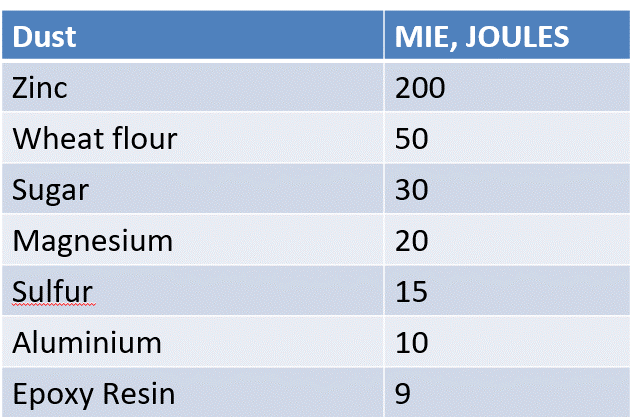
As per Section 5.3.3.4 of NFPA 77 “To be capable of causing ignition, the energy released in the discharge must be at least equal to the minimum ignition energy (MIE) of the ignitable mixture.”

- MIE of Combustible Solids
- Fine Dispersion: – As per section 3.3.7 NFPA-77
- Any finely divided solid material that is 420 microns or smaller in diameter that presents a fire or explosion hazard when dispersed and ignited in air or other gaseous oxidizer.
- What are effective ignition sources?
- An ignition source is a process or event which can cause a fire or explosion.
- Open flames, sparks, static electricity, and hot surfaces are all possible ignition sources.
- An explosion can occur when flammable gases or vapors in the air come in contact with an ignition source such as a spark.
- When does an electric charge become an ignition hazard?
- An electrostatic charge by itself does not necessarily represent an ignition hazard.
- Such a hazard exists only when the charge is so high that discharges occur owing to the elecric filed.
- Conditions to ignite a combustible dust:- As per Section 5.3.1 of NFPA 77 “For a static electric discharge to ignite a combustible dust, the following four conditions need to be met:
- An effective means of separating charge must be present.
- A means of accumulating the separated charges and maintaining a difference of electrical potential must be available.
- A discharge of the static electricity of adequate energy must be possible.
- The discharge must occur in an ignitable mixture of the dust.”
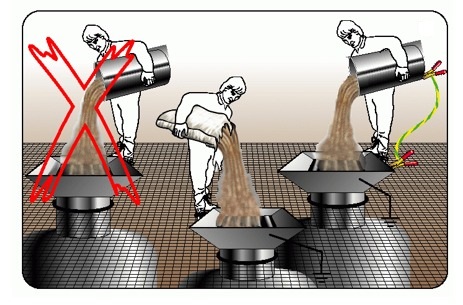
- Protection Measures
- When filling combustible dusts, all conductive parts must be grounded.
- Avoidance of explosive atmosphere by ventilation.
- Inerting to avoid the explosion
- Constructive explosion protection – Explosion suppression
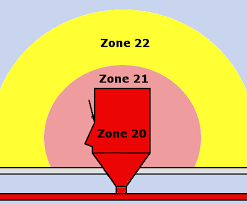
- Classification of Explosive Dust Atmosphere: –
- Areas classified for explosive dust atmosphere are divided into zones , which are identified according to the frequency and duration of the occurrence of explosive dust atmosphere.
- ZONE 20 – A place in which an exlosive dust atmosphere, in the form of a cloud of dust in air, is present continuously, or for long periods or frequently
- ZONE 21 – A place in which an exlosive dust atmosphere, in the form of a cloud of dust in air, is likely to occur in normal operation occasionally
- ZONE 22 – A place in which an exlosive dust atmosphere, in the form of a cloud of dust in air, is not likely to occur in normal operation but, if it does occur, will persist for a short period only